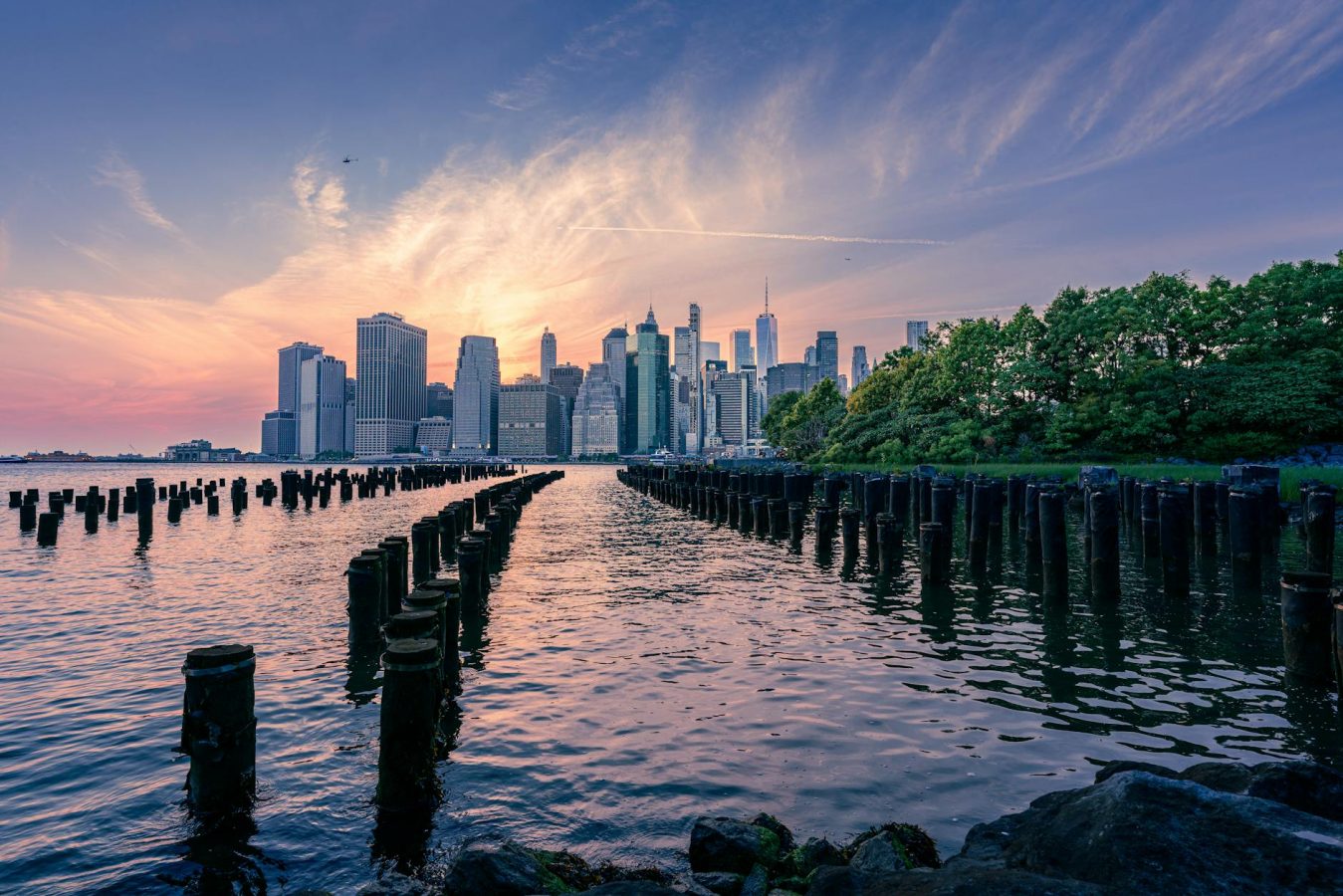
Everyone goes to DUMBO or Brooklyn Bridge Park for the Manhattan skyline at golden hour. Those spots are classics for a reason. But if you want a portfolio shot that does not look like everyone else's, go a little further north to Williamsburg. Skip Bedford Avenue and walk the quiet stretches of the waterfront instead.
Why Williamsburg for golden hour
At the popular spots you end up fighting other photographers for the same angle. Williamsburg does not have that problem.
The light is also different. When the sun drops behind the Manhattan skyline, it hits the Williamsburg waterfront at a low angle. You get long shadows and a warm, soft glow that bounces off the East River. The skyline is still behind you, but the foreground changes: reflections, architectural details and city life instead of one big panorama.
Beyond the usual spots
When we tell clients and new models to meet us in Williamsburg for golden hour, they usually expect the bridge or a cobblestone street in DUMBO. We take them to Domino Park, then to the paths linking it to Bushwick Inlet Park, and further north to Transmitter Park. You trade historic architecture for industrial and modern design, and for open space that is hard to find in a dense city. That gives you more variety, from wide urban views to portraits framed by rust, concrete and water.
Quieter spots along the waterfront
These are the places we have shot some of our best golden hour frames.
The northern edge of Domino Park
Most people stay near the old refinery structure and the fountain. Walk past the main lawn toward the northernmost pier instead. The quieter benches and walkways are there. As the sun drops, the rust and concrete of the old Domino Sugar Factory pick up orange and purple. Reflections are strong here, especially after rain. The low sun throws shadows from the railings and sculptures, which adds depth to a portrait. The skyline from this side is more layered, with buildings peeking out from behind the industrial structures.
Bushwick Inlet Park and its piers
Bushwick Inlet Park is just north of Domino and gets less attention. It has large green spaces, and its small piers stick out into the East River. The light on the piers is uninterrupted and warm. You can shoot silhouettes against the skyline, or use the low light on a model's face. The water often works like a mirror and doubles the color. There are fewer people, so you can take your time and try things. The weathered wood of the piers makes good leading lines toward the city.
Transmitter Park
In Greenpoint, Transmitter Park feels wilder than the manicured lawns at Domino. The long grass on the knolls catches the golden light and makes a soft backdrop for portraits. As the sun sets, the light on the Manhattan skyline from here looks almost cinematic. The small beach is not for swimming, but wet sand gives you reflections, and a model walking the shoreline makes a good frame. The old WNYC radio transmission tower also works as a silhouette against the sky. This spot is calmer than the others, which suits quiet portraits.
Working with the light and reflections
Golden hour is short in NYC, and buildings can cut off the light quickly. Plan ahead.
Use the reflected light
The East River is a large natural reflector. It bounces warm light back onto your subject. On calm days you get mirror-like reflections of the skyline and the sky, which you can use to frame a subject or build a symmetrical shot. Look for puddles too. After a quick rain, even a small one reflects color. We often position models so the light bouncing off the water lands on their face. It works as a soft fill that strobes do not match, and it makes skin tones glow.
Silhouettes and lens flare
As the sun gets lower, shoot straight into it. Put your model against the sky and the city lights and let the shape do the work. A little controlled flare can add a dreamy look. An aperture of f/11 to f/16 often gives a nice sun star. Check that the flare does not take over the subject.
Stay for blue hour
Do not pack up when the sun goes down. The period right after sunset, called blue hour, gives a different light. The sky turns deep blue and the city lights get brighter. The cool sky against warm building lights suits moody portraits and wide cityscapes. The light is softer and more even. We often plan sessions to run into blue hour so we get two moods in one shoot. The ambient light is still strong enough that you do not need much artificial lighting.
Gear and settings
Lenses
We usually carry two lenses, a zoom and a fast prime. The zoom is a 24-70mm f/2.8. It covers wide shots of the waterfront and tighter portraits without a lens change, and f/2.8 is fast enough for low light with good background blur. For closer portraits we switch to a 50mm f/1.4 or an 85mm f/1.4. These let us keep ISO low and isolate the model from the background.
Camera settings
The light changes fast, so we start in Aperture Priority (Av or A). We set f/2.8 to f/5.6 for portraits and f/8 to f/11 for landscapes, and let the camera pick the shutter speed. Watch it: for handheld portraits, stay at 1/125th of a second or faster. ISO stays at 100 or 200 when possible, and goes up to 800 or 1600 as the light fades. For white balance, set "Cloudy" or "Shade" to push the warm tones, or shoot RAW and adjust later. Underexpose slightly to protect highlights in the sky. You can lift shadows in editing.
Accessories
Bring a sturdy tripod if you plan to shoot into blue hour or try long exposures for smooth water. A polarizing filter cuts glare on the water and deepens the sky, but it can dull the warmth of the golden light. A small silver or gold reflector bounces light onto a backlit model's face. Carry extra batteries and memory cards. A lens cloth helps too, since salty air near the river leaves residue.
Editing golden hour photos
Warmth and contrast
We want to keep the natural warmth and contrast without making the image look fake. Start with white balance, nudged warmer if you missed it in camera. Then raise "Highlights" and "Shadows" to recover detail in the bright sky and the dark areas. A slight increase in "Clarity" and "Dehaze" adds punch to the cityscape, but go easy. A radial or gradient filter lets you add warmth and exposure only where the light fell, in the sky or on the water.
Color grading
Split toning works well here. Add a warm tint (orange or yellow) to the highlights and a cooler one (blue or purple) to the shadows. It mimics the color shift of twilight. A touch of "Grain" gives a filmic look, and a slight "Vignette" pulls the eye to the center. Keep all of it subtle. You are bringing out what was already there.
Where to go
Try the East River waterfront in Williamsburg on your next golden hour shoot: the northern edge of Domino Park, the piers at Bushwick Inlet Park, and Transmitter Park in Greenpoint. To book a shoot with us, visit dantet9.com. If you want to plan your own, try our free photography tools.
Cover photo by Ramon Perucho on Pexels.