Lighting often decides whether a photo looks amateur or professional. One widely quoted figure says viewers form an opinion of an image in about 50 milliseconds. Poor light can sink a model's portfolio or a brand campaign. Good light shapes features, sets the mood and holds the eye. This guide covers the lighting gear we think matters, from studio setups to light kits you can carry around New York City.
Key lighting equipment for studio shoots
In a studio you have power, space and a wide choice of tools, so you can shape the light precisely.
Strobes vs. continuous lights
- Strobes (monolights or pack-and-head systems): A strobe gives a powerful, instant burst of light. It freezes motion, overpowers ambient light and gives crisp fashion shots. Strobes usually have more power and faster recycle times than continuous lights, which is why many fashion and modeling photographers in New York use them. The drawback is that you can't see the exact effect until the flash fires, though modeling lamps help.
- Continuous lights (LED or tungsten): These stay on, so you see the effect of your setup as you work. Modern LED panels stay cool, use little power and are often bi-color or RGB. They suit video and work for stills, especially for beginners who want to see their light. They usually have less power than strobes, which limits you in very bright scenes or with large modifiers.
Essential modifiers
- Softboxes: The workhorse of studio lighting, in square, rectangular and strip shapes. They give soft, even light that wraps around the subject. Large ones suit full-body fashion shots and smaller ones give more focused light.
- Octaboxes: Like a softbox but octagonal. They give a round catchlight in the eyes, similar to the sun, and a wrap-around light that works for beauty and portraits.
- Beauty dishes: Crisper than a softbox, softer than bare flash. They give contrasty light with a flattering fall-off, good for beauty and fashion portraits. They often come with grids to control spill.
- Grids: Fit them to softboxes, octaboxes or beauty dishes to narrow the beam, reduce spill and make the light more focused.
- Reflectors and flags: Simple, and you need both. Reflectors bounce light back onto the subject and fill shadows. Flags are black fabric that block light, which deepens shadows.
Light stands and triggers
- Light stands: Buy sturdy ones. C-stands are heavy-duty and good for large modifiers or booms. Roller stands move easily. Don't skimp, because a falling light is an expensive accident.
- Triggers: Wireless radio triggers fire your strobes remotely. Look for reliable brands that offer TTL (Through-The-Lens) and manual control.
Portable lighting for on-location NYC shoots
New York gives you a lot of backdrops, from the grit of Brooklyn to the polish of Manhattan. Shooting on location needs a different approach to light.
Speedlights (external flashes)
These compact, battery-powered flashes can sit on the camera's hot shoe, but they work best off-camera with a wireless trigger. A couple of speedlights with small modifiers like umbrellas or mini softboxes can light a portrait or add pop to a fashion shot, even in bright New York sun. Look for high-speed sync (HSS) to balance flash against bright ambient light, and TTL for quick adjustments.
LED panels
Portable LED panels are light, battery-powered and usually adjustable in color temperature and brightness. They work for fill, for subtle highlights, or as the main light in low light. Many are bi-color (warm to cool) and some offer RGB for color effects on a street fashion shoot.
Reflectors
A 5-in-1 reflector is a collapsible disc with gold, silver, white, black and translucent surfaces.
- Silver: Adds contrast and a punchy look.
- Gold: Adds warmth, good for golden hour or warming skin tones.
- White: Soft, neutral fill for subtle shadow control.
- Black: Works as a flag. It absorbs light for deeper shadows and more drama.
- Translucent: Diffuses harsh direct sun into soft light.
A reflector is light and inexpensive, and it needs no power outlet.
Basic lighting setups
Know these patterns and you can make flattering, consistent images.
Clamshell lighting
Two lights, or one light and a reflector. One light sits above and slightly in front of the subject, angled down. The second light or reflector sits below, angled up, and fills the shadows from the top light. The result is soft, even and open. It's a go-to for beauty shots, headshots and portraits, and a good fit for a model's portfolio.
Butterfly (Paramount) lighting
It's named for the butterfly-shaped shadow under the nose. A single main light goes directly in front of the subject and slightly above, angled down. It emphasizes cheekbones and jawlines and gives a defined, sculpted look. It's a classic for beauty and glamorous fashion portraits.
Rembrandt lighting
Rembrandt lighting leaves a small, inverted triangle of light on the cheek opposite the main light, while the rest of that side of the face stays in shadow. You get it by placing a single light off-axis, typically 45 degrees to the subject and slightly above eye level. It's dramatic and moody, and often used for strong portraits or fashion editorials.
Practice these in a studio first, then adapt them with portable gear for location shoots.
Gear for different budgets
You don't need to spend a fortune to start.
Entry-level (under $700)
- Lights: One or two Godox TT600/V1 speedlights (manual/TTL), and a small bi-color LED panel (e.g., Neewer 660).
- Modifiers: A 5-in-1 reflector, and a couple of small umbrellas or mini softboxes for the speedlights.
- Stands and triggers: Two basic but sturdy light stands, and a reliable wireless trigger (e.g., Godox XPro).
This works for both studio-style setups and location shoots in NYC.
Mid-range ($1000 to $2500)
- Lights: Two Godox AD200Pro or AD400Pro strobes (powerful, portable, versatile), or a couple of Elinchrom D-Lite RX ONE/RX4 monolights.
- Modifiers: A good large softbox (e.g., 36x48 inches), an octabox (36-inch), and a beauty dish (22-inch) with a grid.
- Stands and triggers: Two C-stands or heavy-duty light stands, and a professional-grade wireless trigger system.
This level gives more power, faster recycling and more precise light shaping, which suits professional fashion and modeling work.
Professional ($3000+)
- Lights: Profoto B10/B1X units, Broncolor Siros, or Elinchrom ELC Pro HD monolights. They have excellent build quality, color consistency and advanced features.
- Modifiers: A wide range from your chosen brand (e.g., Profoto RFi softboxes, Broncolor Para).
- Stands and triggers: Multiple C-stands, boom arms, rolling stands and a full set of grip equipment.
At this level you're paying for reliability, consistency and light quality for high-end campaigns and editorial work.
The most expensive gear doesn't guarantee the best results. A skilled photographer with modest equipment will outperform an amateur with high-end tools. Learn the light first, then upgrade as your skills and budget allow.
Our studio
Dante's Models has a NYC photography studio equipped with professional lighting. Models building a book and brands needing fashion imagery can book a consultation at dantet9.com.
This post contains affiliate links. If you purchase through these links, we may earn a small commission at no extra cost to you.
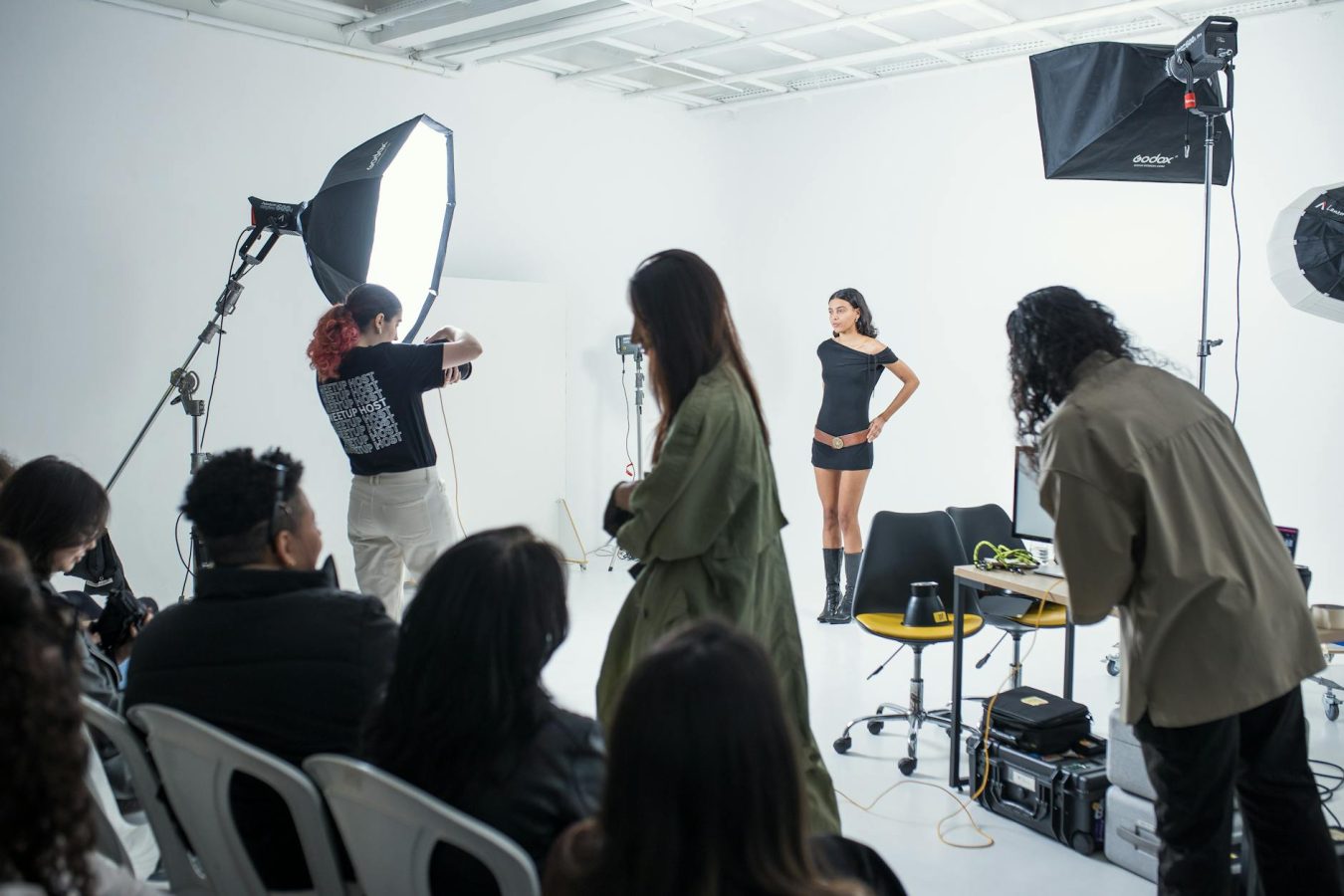
Photo by Matheus Bertelli on Pexels